

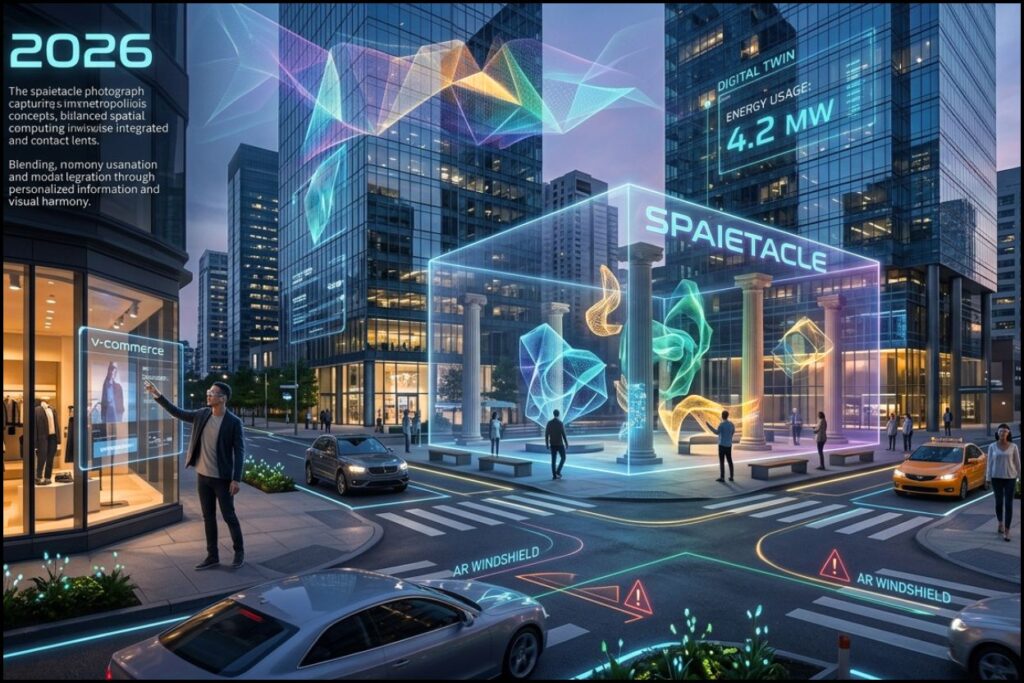
The digital and real worlds finally merged in 2026. This new era is called the spaietacle—a powerful blend of space, technology, and stunning design. We are no longer just looking at screens from the outside. Now, we step inside them. We move, interact, and experience everything in full 3D around us. This is not just an upgrade in technology. It is a complete shift in how we live, work, and connect. The future is no longer something we watch—it is something we fully experience.
The global market has embraced this trend as the primary driver for consumer engagement. Whether we shop, work, or entertain ourselves, the demand for high-impact visual experiences is at an all-time high. Innovation is no longer measured solely by speed, but by the depth of the experience provided to users.
The Core Foundations of the Era
To understand the spaietacle, one must look at the convergence of 6G connectivity and advanced neural interfaces. These technologies enable a seamless overlay of digital information onto the physical world without lag. Consequently, every street corner can now become a hub of information and art, tailored specifically to the viewer.
Furthermore, the hardware supporting the spaietacle has become nearly invisible. Contact lenses and lightweight glasses have replaced bulky headsets, making the immersion feel natural. This transparency allows the technology to enhance reality rather than distract from it. We are witnessing the death of the “black mirror” screen in favor of a vibrant, world-sized canvas.
The Role of Spatial Computing
Spatial computing is the engine that drives every immersive display. It allows machines to understand the physical context of a room or a city. Because the software knows where objects are, it can place digital elements that interact realistically with the environment. For example, a digital character can sit on a real chair or hide behind a physical wall.
This level of realism has revolutionized interior design and urban planning. Architects now design buildings with “digital twin” layers that serve as a permanent spaietacle for residents. These layers can show real-time energy usage, historical data, or even seasonal decorations that don’t require physical storage.
Breaking Down the Visual Aesthetics of 2026
The aesthetic of the modern spaietacle is defined by fluid geometry and hyper-realistic lighting. In 2026, we have moved past the “pixelated” look of the early metaverse. Today’s experiences feature textures that are indistinguishable from reality, achieved through real-time ray tracing and AI-driven generation.
Moreover, the use of color has become more dynamic. A display can shift its color palette based on the time of day or the emotional state of the crowd. This creates a living environment that breathes and evolves. Designers focus on “visual harmony” where digital elements complement the natural beauty of the physical world.
Transforming Global Industries
Every major sector is feeling the impact of this trend. In retail, the “v-commerce” boom has changed how we buy goods. Customers can now enter a store and see a spaietacle of products customized to their size and style instantly appearing on mannequins. This has reduced return rates by 40%.
In the automotive industry, the technology has moved into the windshield. Drivers see navigation lines projected onto the road, highlighting hazards in high definition. Therefore, safety and entertainment are merged into a single, cohesive experience that makes every journey more enjoyable.
Education and the Immersive Classroom
The classroom of 2026 is a far cry from the traditional desks of the past. Education has become a curated spaietacle where students can walk through a digital recreation of the Jurassic period. This hands-on approach has made complex subjects like physics much more accessible.
Teachers now act as “experience directors,” guiding students through these digital realms. Research shows that students who use these immersive methods retain information 70% better than those who use traditional textbooks. By turning a lesson into a spaietacle, we are fostering a deeper love for learning.
The Evolution of the Professional Workspace
Remote work has evolved into “presence work.” Even if team members are thousands of miles apart, they can gather in a shared digital space that feels entirely real. This collaborative spaietacle allows for the manipulation of 3D models as if they were physical objects on a table.
Consequently, office culture has been redefined. Companies are no longer investing in massive physical buildings. Instead, they invest in high-quality spatial environments that represent their brand values. This shift has significantly reduced overhead costs while increasing employee satisfaction.
The Psychological Power of Immersion
Human psychology is deeply influenced by our surroundings. A well-designed spaietacle can reduce stress, increase focus, and improve mood. In 2026, mental health professionals are using “therapeutic spectacles” to treat anxiety and PTSD by placing patients in controlled, calming environments.
However, this power comes with responsibilities. Designers must be careful not to create “visual clutter” that overwhelms the senses. The most effective spaietacle is one that knows when to be bold and when to be subtle. Balance is the key to maintaining long-term engagement without causing sensory fatigue.
Understanding Consumer Cravings for Awe
Why are people so drawn to the spaietacle? The answer lies in our biological craving for awe. Moments of wonder trigger the release of dopamine. In an increasingly automated world, these experiences provide the human touch—the spark of creativity that makes life feel extraordinary.
Brands that successfully deliver a high-end experience find that their customers become advocates. When a person witnesses a breathtaking spaietacle, their first instinct is to capture it and share it. This organic reach is the holy grail of modern marketing.
Ethical Considerations and Sustainability
As these displays become integrated into society, ethical questions arise. Who owns the “digital air” in a public space? In 2026, new laws define visual property rights to protect citizens from intrusive advertising. Furthermore, accessibility features, such as haptic feedback, are becoming standard to ensure the spaietacle remains inclusive.
Sustainability is also a priority. Unlike physical events that produce waste, a digital spaietacle has a much smaller environmental footprint. We are seeing a rise in “eco-spectacles” that use low-energy displays and carbon-neutral servers to promote green living.
The Future: Sentient Environments
Looking beyond 2026, we anticipate that the spaietacle will become even more interactive. We are moving toward “sentient environments” that can anticipate our needs. A kitchen display might highlight recipe ingredients as soon as you think about cooking.
The integration of haptic technology will eventually allow us to “touch” the digital world. The boundary between what is real and what is a spaietacle will continue to thin until it disappears entirely.
Conclusion
The spaietacle stands as a testament to human ingenuity, culminating decades of research in optics and computing. It has made our world more beautiful and connected, turning the mundane into the extraordinary.
As you navigate the modern age, look for the spaietacle in your own life. Whether it is a grand public installation or a small moment of digital beauty in your home, these experiences define our evolution. The future is bright, and it is waiting for you to step inside.
