

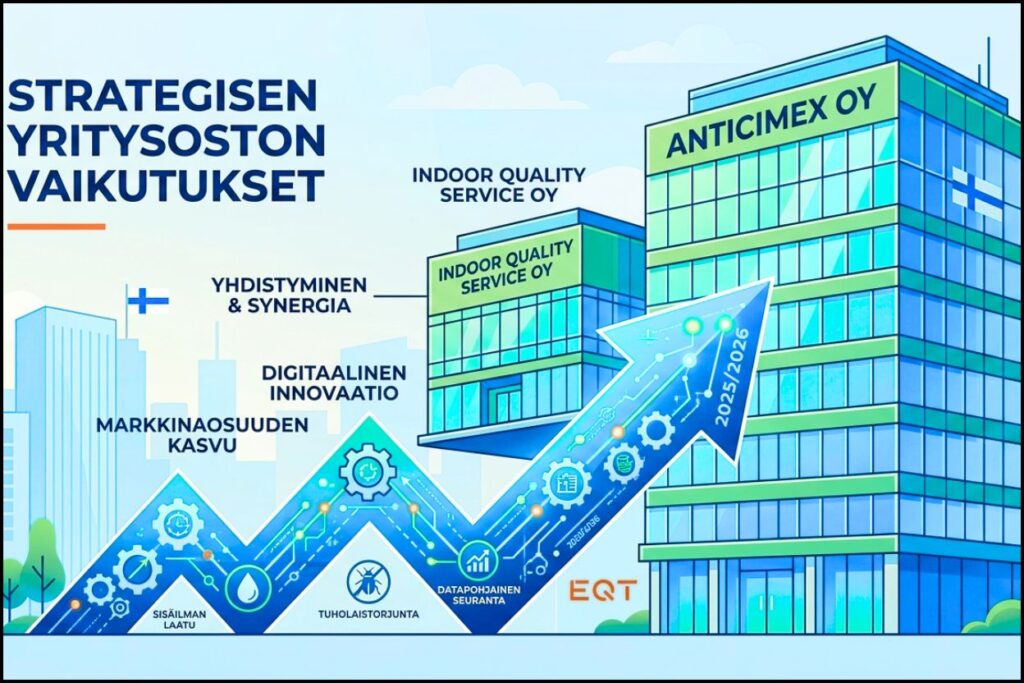
The landscape of the Finnish pest control and building environment industry shifted significantly when Anticimex Oy acquired Indoor Quality Service Oy (IQS). This strategic move was not merely a local merger but a calculated step within a global “Buy and Build” framework. As we look at the trajectory from 2025 into 2026, understanding the anticimex oy / indoor quality service oy yritysostostrategia remains essential for analyzing market consolidation in Northern Europe.
The Foundation of the Acquisition Strategy
Anticimex serves as a global leader in modern pest control and environmental services. Consequently, their growth model relies heavily on identifying local gems that possess specialized expertise or strong regional footprints. When they targeted Indoor Quality Service Oy, the primary objective centered on strengthening their service portfolio in the capital region of Finland.
Indoor Quality Service Oy was a well-respected player known for its agility and technical proficiency. Therefore, the acquisition enabled Anticimex to acquire a competitor while simultaneously gaining access to a loyal public-sector client base. This specific approach highlights a core pillar of their strategy: acquiring companies that already demonstrate high operational efficiency.
By 2025, the results of this integration have become even more apparent. The merged entity operates with a unified vision that prioritizes digital transformation over traditional methods. Furthermore, the transition of key personnel from IQS to Anticimex ensured that the intellectual capital and local relationships remained intact throughout the process.
Strategic Synergy and Market Positioning
Synergy occurs when two companies combine to create a value greater than the sum of their individual parts. In the case of the anticimex oy / indoor quality service oy yritysostostrategia, the synergy was both operational and cultural. While Anticimex brought massive resources and international branding, IQS contributed deep local knowledge and specialized indoor air quality insights.
In addition to market share, the acquisition focused on diversifying revenue streams. Traditionally, pest control can be seasonal or reactive; however, indoor quality services often involve long-term monitoring and maintenance. This shift toward recurring revenue models is a hallmark of the 2025 business environment in Finland.
Modern Pest Control Trends in 2025 and 2026
The pest control industry is no longer just about traps and sprays. Currently, the market demands high-tech solutions that align with environmental regulations. Anticimex has led this charge by introducing the SMART system, which uses digital sensors to monitor activity in real-time.
Because of this technological edge, the acquisition of smaller firms like IQS helps “onboard” more clients into the digital ecosystem. For instance, a customer who previously used IQS for manual inspections can now be upgraded to automated, 24/7 monitoring systems. This strategy increases the lifetime value of every customer acquired through the merger.
Moreover, sustainability has become a non-negotiable requirement for Finnish municipalities. Therefore, the combined expertise of Anticimex and IQS allows the company to offer “biocide-free” solutions. These methods are safer for schools, hospitals, and residential complexes, which were key markets for Indoor Quality Service Oy.
The Role of Digitalization in Growth
Digitalization acts as the backbone of the current anticimex oy / indoor quality service oy yritysostostrategia. When a large corporation acquires a smaller one, the first step involves standardizing data collection. By 2026, all field operations have been streamlined into a single cloud-based platform.
This platform allows technicians to report findings instantly, providing clients with immediate transparency. In addition, AI-driven analytics now predict potential infestations before they become critical. Such proactive service was a primary goal when Anticimex decided to expand its footprint through the acquisition of IQS.
Analyzing the “Buy and Build” Model
The “Buy and Build” model is a favorite of private equity-backed firms like Anticimex. It involves purchasing a “platform” company and then adding smaller “bolt-on” acquisitions. In this context, IQS served as a perfect bolt-on, adding density to the existing Finnish network.
By 2025, this strategy has proven effective in mitigating the risks of organic growth. Instead of spending years trying to win over individual clients, Anticimex simply buys the companies that those clients already trust. This method accelerates market penetration and provides an immediate boost to the bottom line.
However, the success of this model depends on effective integration. Anticimex avoids the common mistake of stripping away the local identity too quickly. Instead, they focus on empowering the local teams with better tools while maintaining the personal touch that made companies like IQS successful in the first place.
Human Capital and Leadership Integration
One of the most critical aspects of the anticimex oy / indoor quality service oy yritysostostrategia was the retention of talent. Specifically, the leadership from IQS stayed with the organization to lead the transition. This continuity prevented morale from dipping and ensured service levels did not drop during the handover.
In 2026, the industry sees a shortage of skilled environmental technicians. Consequently, acquiring a company with a trained workforce is often more valuable than acquiring its physical assets. Anticimex recognizes that their “product” is the expertise of their people, making human capital a top priority during any audit.
Expansion into Indoor Air Quality Services
The “Indoor Quality Service” name itself suggests an expertise that goes beyond rats and insects. Indoor air quality (IAQ) has become a massive concern for property managers across Finland. Therefore, the acquisition allowed Anticimex to pivot toward a more holistic “healthy building” approach.
As we move through 2026, the demand for moisture measurements and VOC (Volatile Organic Compound) testing continues to rise. By integrating the IQS skill set, Anticimex can now offer a one-stop-shop for property health. This cross-selling strategy is a direct result of the thoughtful anticimex oy / indoor quality service oy yritysostostrategia.
Addressing the Needs of Property Managers
Property managers in Helsinki and surrounding areas face strict regulatory requirements. They need partners who can handle everything from pest prevention to mold audits. Because Anticimex has absorbed IQS’s capabilities, they are now uniquely positioned to sign comprehensive service agreements.
These agreements often span several years, providing the financial stability needed to invest in further innovation. Furthermore, the use of transition words in their reporting—such as “consequently” and “as a result”—helps property managers understand the cause-and-effect relationship between environmental factors and building health.
Competitive Landscape in Finland 2025-2026
The Finnish market is highly competitive, with several international and local players vying for dominance. Nevertheless, Anticimex’s scale gives them a distinct advantage. Their ability to invest in R&D and global supply chains enables them to offer pricing that smaller independent firms struggle to match.
Despite this dominance, the company remains humble enough to pursue smaller acquisitions. This indicates that the anticimex oy / indoor quality service oy yritysostostrategia is still active and relevant. They are constantly looking for the next IQS—a company that is small enough to be nimble but large enough to have a significant local impact.
In addition, the focus on ESG (Environmental, Social, and Governance) criteria has changed how these deals are evaluated. Now, an acquisition must not only be profitable but also environmentally responsible. Anticimex ensures that their partners align with their goal of reducing chemical usage across the board.
The Future of Smart Monitoring
Looking ahead to the remainder of 2026, smart monitoring will likely become the industry standard. Anticimex has already deployed thousands of SMART traps across Finland. These devices communicate via cellular networks, providing a constant stream of data to the central hub.
The data collected from these sensors allows for “heat mapping” of pest activity across entire cities. Consequently, the company can deploy technicians more efficiently, reducing fuel consumption and carbon footprints. This level of sophistication is exactly why the anticimex oy / indoor quality service oy yritysostostrategia was so forward-thinking.
Financial Implications of Consolidation
Consolidation in the service industry typically leads to higher margins through economies of scale. For example, Anticimex can negotiate better rates for equipment and insurance than IQS could as a standalone entity. These savings can then be reinvested into employee training or new technology.
Furthermore, the brand recognition of Anticimex helps in winning large-scale tenders. When a government agency seeks a service provider, it prefers a company with a proven track record and significant financial backing. The acquisition of IQS helped build the necessary “bulk” to compete for these high-value contracts.
In 2025, financial analysts noted that Anticimex Finland’s revenue growth outperformed the general market. This success is directly attributable to their aggressive but disciplined acquisition strategy. They do not just buy any company; they buy the right company at the right time.
Operational Excellence and Quality Control
Maintaining quality after an acquisition is a major challenge. To combat this, Anticimex uses a rigorous onboarding process for all new employees. They are trained in the “Anticimex Way,” which emphasizes safety, documentation, and customer service.
Since the IQS team already had a culture of excellence, their integration was smoother than most. The use of clear subheadings in their internal manuals helps keep everyone on the same page. This attention to detail is why they remain at the top of the Finnish market in 2026.
Lessons for the Service Industry
Other companies can learn a great deal from the anticimex oy / indoor quality service oy yritysostostrategia. First, do not underestimate the value of local expertise. Second, ensure that technology is the bridge that connects the old organization to the new one.
Moreover, the importance of clear communication cannot be overstated. Throughout the acquisition, Anticimex kept both employees and customers informed. This transparency built trust and prevented the “client churn” that often plagues mergers in the service sector.
Finally, always look for complementary services. If you are in pest control, look at air quality. If you are in cleaning, look at maintenance. Expanding each customer’s “wallet share” is the fastest way to grow in a mature market like Finland.
Strategic Roadmap for 2026 and Beyond
As 2026 progresses, Anticimex will likely continue its path of innovation. We can expect to see more integration of drone technology for roof and gutter inspections. Additionally, pheromone-based traps and biological controls will likely replace the few remaining chemical options.
The anticimex oy / indoor quality service oy yritysostostrategia set the stage for this evolution. It proved that a global giant could successfully integrate a local specialist without losing the essence of what made the local company great. As a result, the Finnish building environment is safer and healthier today.
In conclusion, the partnership between Anticimex and the legacy of IQS represents a milestone in the Finnish service industry. It demonstrates how a clear vision, supported by digital tools and a focus on sustainability, can redefine a market. For stakeholders and competitors alike, this case study remains the gold standard for strategic growth in the Nordics.
