

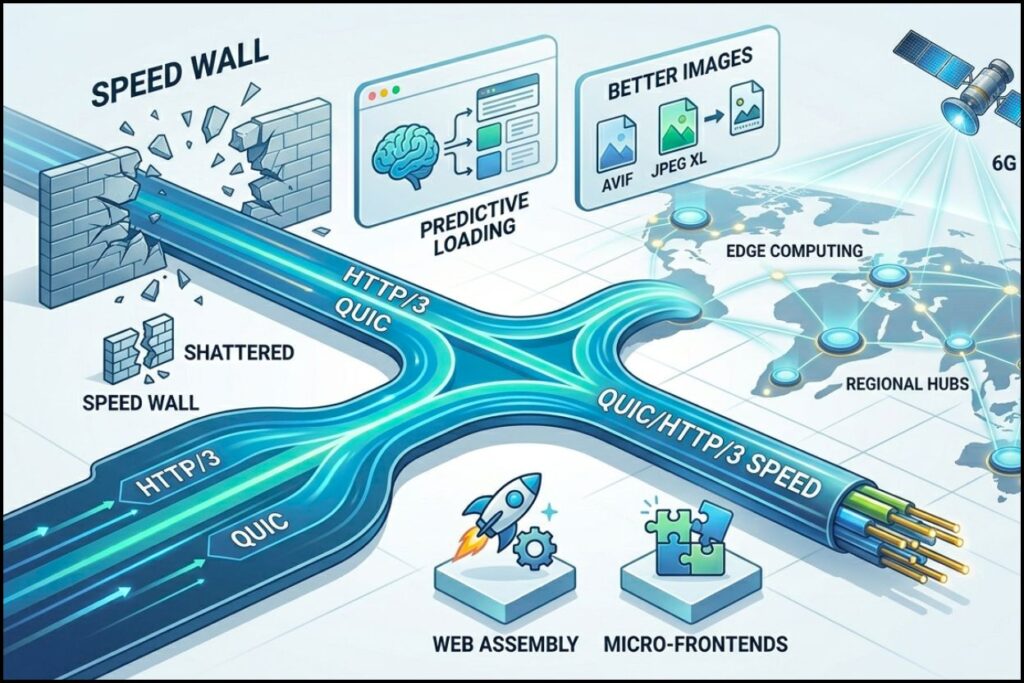
The internet in 2026 feels almost instant. Pages appear the moment you tap, videos start without waiting, and users expect everything to load in a blink. The days of staring at loading bars are gone. This transformation didn’t happen by chance. It came from powerful tech ideas that made the web move quicker, changing how data travels and how websites respond. In this guide, we break down the innovations behind this speed revolution and how they reshaped the digital world forever.
The Shift to HTTP/3 and the QUIC Protocol Standard
At the heart of the modern internet lies a fundamental change in how computers talk to each other. For decades, the Transmission Control Protocol (TCP) was the standard, but its “heavy” nature caused significant lag. The introduction of the QUIC protocol, which forms the basis of HTTP/3, is one of the most vital tech ideas that made the web move quicker.
Why Zero-RTT is a Game Changer
In 2026, Zero Round-Trip Time (0-RTT) resumption is the standard. In older systems, your browser had to “handshake” with a server multiple times before any data was sent. Now, if you have visited a site before, the browser sends data immediately. This results in a connection that feels local, even if the server is thousands of miles away.
Eliminating Head-of-Line Blocking
One major flaw of previous web versions was that a single lost packet could freeze the entire page load. QUIC handles data streams independently. Therefore, if a single image fails to download, the rest of the text and styling continue to load without interruption. This resilience is a core reason why mobile browsing on 5G and 6G networks feels so fluid.
Edge Intelligence and Regional Compute Hubs
Distance remains the greatest enemy of speed. To solve this, developers moved away from centralized “origin” servers. Instead, they embraced Edge Computing, which places the website’s “brain” at the nearest network node to the user.
The Evolution of Edge SEO
Search engines now reward sites that use Edge SEO. This involves running SEO optimizations, like injecting meta tags or redirecting URLs, directly at the CDN level. Because these changes happen at the edge, the browser receives a perfect, optimized file in milliseconds. This is a brilliant example of tech ideas that made the web move quicker while simultaneously improving search rankings.
Persistent Edge State (PES)
In 2026, we moved beyond simple caching. New “Persistent Edge State” technologies allow databases to live at the edge. Previously, an e-commerce site had to check a central database for stock levels. Now, that data is synced across regional hubs globally. This ensures that even complex, dynamic websites load as fast as a simple text file.
AI-Driven Predictive Resource Loading
One of the most futuristic tech ideas that made the web move quicker is the integration of machine learning directly into the browser’s fetch engine. We are no longer just reacting to user clicks; we are predicting them.
Neural Pre-fetching Models
Modern browsers use lightweight neural networks to analyze your scrolling patterns. If the AI detects that you are likely to click a “Read More” button, it preloads the content in the background. By the time your finger hits the screen, the data is already there. This “anticipatory web” has reduced perceived loading times to virtually zero.
Smart Asset Prioritization
Not all code is created equal. AI now sorts a website’s assets in real-time, deciding which scripts are “critical” and which can wait. For instance, the AI ensures the text you are currently reading is rendered before the invisible tracking pixels or footer icons. This intelligent sorting makes the web move quicker by focusing on what the human eye actually sees first.
Advanced Media Codecs: Beyond WebP and AVIF
Images and videos used to be the heaviest part of any webpage. However, new compression technologies have shrunk these files without losing a single pixel of clarity. This evolution is a primary pillar among tech ideas that made the web move quicker.
The Adoption of JPEG XL and H.266
While AVIF was a great leap, 2026 has seen the widespread adoption of JPEG XL and the H.266 (VVC) video codec. These formats offer 30-50% better compression than their predecessors. Smaller files mean less data to transfer, which is especially important for users in regions with developing infrastructure.
Real-Time Vector-Based UI
Instead of using heavy PNG or JPG files for interface elements, modern websites now use complex SVG vectors and Lottie animations. These are mathematical instructions rather than pixel maps. Because they are tiny and infinitely scalable, they load instantly across any screen resolution, contributing to a snappier user interface.
WebAssembly (Wasm) and the Death of “Heavy” JavaScript
JavaScript was never intended to run complex applications, yet we forced it to do so for years. WebAssembly is one of the revolutionary tech ideas that made the web move quicker by allowing developers to run high-performance code in the browser.
Bringing Desktop Power to the Browser
WebAssembly allows languages like C++, Rust, and Zig to run at near-native speeds. This means photo editors, 3D games, and data visualization tools that used to crash browsers now run smoothly. By moving heavy computation away from the main JavaScript thread, the browser remains responsive and fast, even under heavy loads.
Modular Micro-Frontends
Developers now break large applications into tiny, independent “micro-frontends.” Instead of loading a 5MB JavaScript bundle, the browser loads only the 50KB needed for the section you are viewing. This “just-in-time” code delivery is a major reason why modern enterprise platforms no longer feel sluggish.
The Impact of 6G and Satellite Mesh Networks
Hardware and infrastructure have finally caught up with software. The rollout of 6G and low-earth-orbit (LEO) satellite constellations has changed the physical path data takes.
Terahertz Frequency Communication
6G utilizes higher frequency bands that can carry massive amounts of data with almost no latency. This infrastructure supports the tech ideas that made the web move quicker by providing a wider “pipe” for data to flow through. Even in crowded cities, the interference is minimal, ensuring consistent high-speed access.
Global Connectivity with Zero Lag
Satellite networks have reduced the number of “hops” a data packet takes to cross an ocean. By bypassing old, congested undersea cables, data can take a more direct route through space. This global network optimization ensures that the “quick web” is available to everyone, regardless of their geographic location.
Sustainable Web Performance (The Green Speed Movement)
In 2026, speed is synonymous with sustainability. Heavy websites require more electricity to load and more server power to host. Therefore, the drive for efficiency is also a drive for a smaller carbon footprint.
Low-Carbon Web Protocols
New protocols now negotiate the “cost” of a page load. If a device is on low battery or a slow connection, the server automatically sends a “lite” version of the site. This adaptive delivery ensures that the web moves quicker by respecting the constraints of the user’s current environment.
Efficient Caching Strategies and TTL Optimization
We have seen a massive improvement in how long data stays on a user’s device. By using smarter “Time to Live” (TTL) settings, websites don’t force users to re-download assets they already have. This reduces redundant traffic and keeps the browser’s cache clean and efficient.
Conclusion: The Era of the Instant Web
The accumulation of these tech ideas that made the web move quicker has ushered in an era of digital immediacy. From the invisible handshakes of HTTP/3 to the predictive power of AI, every layer of the internet has been optimized for velocity. As we look further into 2026, the focus remains clear: remove every millisecond of friction between a user’s thought and the information they seek.
Building a fast website is no longer a luxury; it is a fundamental requirement for success in a world where speed is the ultimate currency. By embracing these technologies, we aren’t just making pages load faster—we are making the entire global economy more efficient and accessible for all.
