

Business Vertical Classification Categories
In today’s rapidly evolving market, businesses are exploring every opportunity to gain a competitive advantage. One of the foundational elements of this strategy is understanding business vertical classification categories. These categories help companies organize operations, tailor products or services, and improve communication within and beyond the organization.
The way businesses classify verticals influences decision‑making, marketing strategies, and customer engagement. A vertical classification system groups companies based on shared industry traits. This enables brands to focus on specific markets and optimize resources effectively.
In this comprehensive article, you will learn what business vertical classification categories are, why they matter, how they impact operational strategy, and how they are evolving in 2025 and beyond. Step by step, the concepts are broken into simple, easy‑to‑understand sections so that readers from diverse backgrounds can follow along.
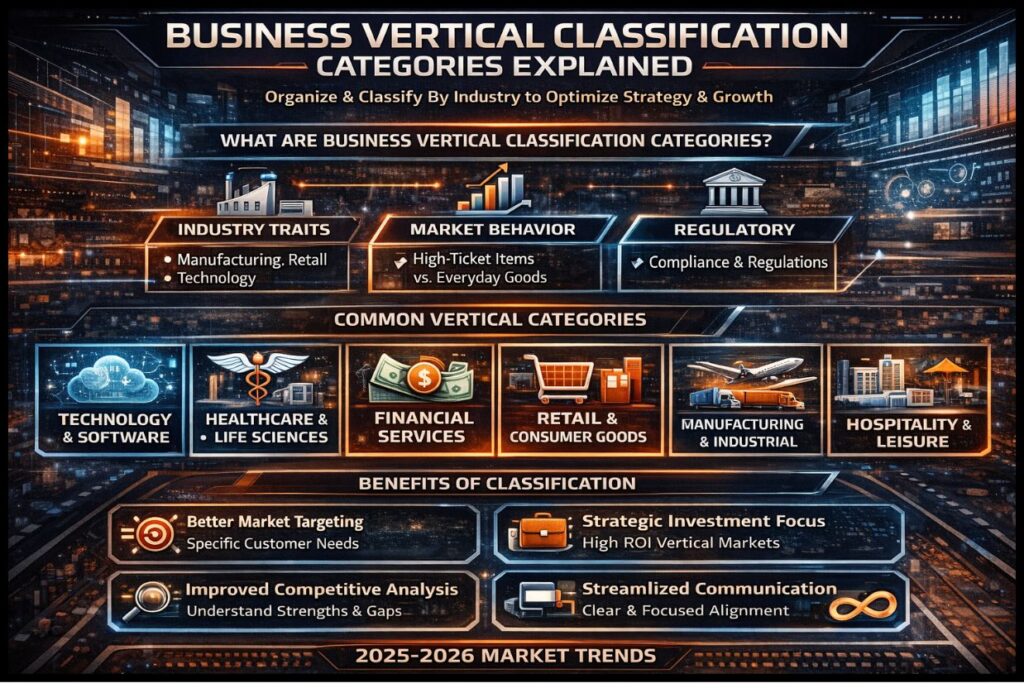
What Are Business Vertical Classification Categories?
At its core, business vertical classification categories refer to organized groups of companies or industries that share similar products, services, or customer segments.
The Purpose of Classification
Classification creates order in complexity. Without clear categories, finding patterns across industries is difficult. When businesses are classified into precise verticals, analysis becomes effortless. Teams know where to invest resources and which markets deserve attention.
Categories help stakeholders understand:
- Which industries show growth potential
- Which sectors exhibit stable demand
- Where competition is most intense
By categorizing businesses into verticals, leaders can prioritize innovation where it matters most.
How Business Vertical Classification Categories Are Defined
Classification of business verticals is not random. It often depends on several factors, such as the product type, client base, business model, and market behavior.
Industry Traits
Industries share distinct traits that separate them from others. For example:
- Manufacturing is focused on creating physical products
- Retail is about selling goods directly to consumers
- Technology concentrates on digital and software solutions
These traits form the cornerstone of business vertical classification categories.
Market Behavior
Market behavior involves how customers interact with a business. Industries that sell high‑ticket items behave differently from those offering everyday goods. Understanding these interactions solidifies how categories are formed.
Regulatory Environment
Various industries face unique government regulations. Healthcare, finance, and education are examples where compliance shapes operations. These regulatory characteristics also influence how verticals are defined.
Common Examples of Business Vertical Classification Categories
Each business sector can be separated into various verticals. Below are some of the most commonly used categories organizations encounter when analyzing markets or planning expansion.
Technology and Software
This vertical includes companies that design, develop, and distribute digital solutions. In 2025 and 2026, this area continues to expand due to rising demand for cloud computing, artificial intelligence, and automation.
Healthcare and Life Sciences
Healthcare remains a critical global vertical. Its categories range from pharmaceutical research to medical device manufacturing. Each sub‑segment serves specific patient needs, healthcare providers, or regulatory frameworks.
Financial Services
From banking to insurance and investment management, financial services represent a diverse classification category. Companies in this vertical focus on efficient handling of money, assets, and risk.
Retail and Consumer Goods
This category includes businesses that sell products directly to end users. It extends to e‑commerce platforms, brick‑and‑mortar stores, and specialty suppliers.
Energy and Utilities
Energy companies provide essential services like electricity, gas, and renewable sources. As sustainability gains importance, many businesses in this vertical are shifting toward greener solutions.
Manufacturing and Industrial
Companies in this vertical produce goods or components for other industries. Their operations include supply chain management, production processes, and quality control.
Transportation and Logistics
This vertical covers services that move people or products from one place to another. Examples range from freight shipping to passenger travel operations.
Education and Training
Education covers formal schooling, vocational training, and digital learning platforms. This vertical adapts rapidly as technology reshapes how people learn.
Hospitality and Leisure
Hotels, restaurants, and entertainment venues fall under this category. This vertical thrives by responding to customer experiences and changing travel trends.
Benefits of Using Business Vertical Classification Categories
Clear business vertical classification categories support many organizational functions, including marketing, product development, and operational planning.
Better Market Targeting
When businesses know the vertical they serve, they can tailor offerings to fit specific customer needs. With precise targeting, messaging becomes clearer, and customer experience improves.
Strategic Investment Focus
Investment decisions are easier when companies understand which verticals yield the best potential returns. Vertical classification provides data‑driven insights for planning budgets and resources.
Improved Competitive Analysis
Competitive landscapes vary across verticals. A company that understands its vertical knows where competitors are strongest and where opportunities can be seized.
Streamlined Communication
Internally, teams benefit from clear classification because it enables better alignment among departments. Externally, partners and stakeholders can also understand business directions quickly.
Enhanced Innovation
Vertical classification enables businesses to recognize emerging trends within specific industries. With this insight, innovation efforts are sharper and more relevant.
Challenges in Defining Business Vertical Classification Categories
Despite the clear benefits, defining and maintaining classifications is not without challenges.
Overlapping Industries
Some companies operate across multiple areas. For example, a technology brand might also sell services to healthcare providers. Determining which vertical best describes the organization can be complex.
Dynamic Market Changes
Markets evolve quickly. Business vertical classification categories must adapt to stay relevant. New industries emerge, such as the sustainability sector, which was less visible a decade ago.
Inconsistent Standards
Different organizations use varying classification systems. While some companies adopt global standards, others use customized taxonomies. Inconsistencies make data analysis difficult when comparing across industries.
How Technology Influences Business Vertical Categorization
Advancements in technology are reshaping how industries are defined and classified. Artificial intelligence, big data, and machine learning allow businesses to analyze patterns more precisely.
Real‑Time Data Insights
With real‑time analytics, companies identify changes in customer behavior and market demand instantly. These insights help refine business vertical classification categories by highlighting emerging micro‑verticals.
AI‑Driven Segmentation
AI tools can group companies into categories based on vast datasets and complex patterns. This improves accuracy and allows for more nuanced categorization, such as distinguishing between sub‑segments within healthcare or technology.
Automation of Classification Processes
Machine learning automates the classification process, making it faster and more efficient. This reduces manual effort and accelerates decision‑making.
Trends Shaping Business Vertical Classification Categories in 2025 and Beyond
As we move deeper into 2025 and early 2026, certain trends are influencing how businesses think about vertical categories.
Sustainability and Green Industries
Sustainability is no longer a buzzword. It is driving investment and creating a distinct vertical in its own right. Businesses are now classified based on environmental responsibility and resource efficiency.
Convergence of Digital and Physical Markets
With the rise of omnichannel retail and digital services, traditional boundaries between verticals are blurring. The integration of digital solutions into physical products is becoming a defining trait of future classification.
Personalized Customer Experience
Businesses that tailor experiences based on individualized preferences challenge old models of categorizing markets. Personalization is influencing how companies define their customer segments within verticals.
Expansion of Service‑Based Models
More companies are moving from product‑centric to service‑centric business models. As a result, service offerings are forming new categories that cut across existing verticals.
How Organizations Can Apply Vertical Classification
Understanding classification is only half the battle. The true value comes from practical application.
Integrated Market Research
Businesses should start with thorough market research. This includes gathering data about competitors, customers, and industry trends. By integrating research results with vertical classification categories, brands can make confident decisions.
Aligning Organizational Structure
Once verticals are identified, companies must align internal structures. Teams should be organized based on business goals associated with specific verticals. This ensures accountability and optimized performance.
Tailored Marketing Plans
With a clear vertical, marketing strategies can be more specific. Customized messaging resonates with the right audience and improves return on investment.
Predictive Analytics for Future Growth
Advanced analytics help companies anticipate shifts in vertical landscapes. Predictive models enable teams to plan for long‑term success and adapt strategies proactively.
The Future of Business Vertical Classification Categories
Looking ahead, businesses will see further refinement in how industries are classified. Innovation, technology, and changing consumer behaviors will influence future systems. Here are some possibilities:
Hyper‑Specific Segmentation
Rather than broad categories, vertical classifications are expected to become more granular. Companies may be grouped based on niche behaviors or micro‑industry traits.
Cross‑Vertical Insights
Future classification systems will highlight relationships across verticals. For example, healthcare and technology may merge into a single hybrid classification where digital health solutions are considered.
Global Standardization
Efforts toward universal systems for business classification are gaining traction. Global standards will enhance comparison and collaboration across borders.
Conclusion
Understanding business vertical classification categories is fundamental for any organization striving to grow and remain competitive. By organizing industries into distinct segments, companies gain insight into strategic planning, customer targeting, innovation, and future forecasting.
In this era of rapid transformation, clear classification aids clarity. Whether a business is navigating established industries or venturing into new markets, vertical classification categories provide a roadmap for success. As 2025 and 2026 unfold, the influence of technology, sustainability, and customer behavior will shape how these categories evolve. Companies that embrace refined classification practices will be better positioned to thrive in an increasingly complex global economy.
READ MORE : Ace Your RN Fundamentals 2016 70 Questions: Ultimate Guide
